
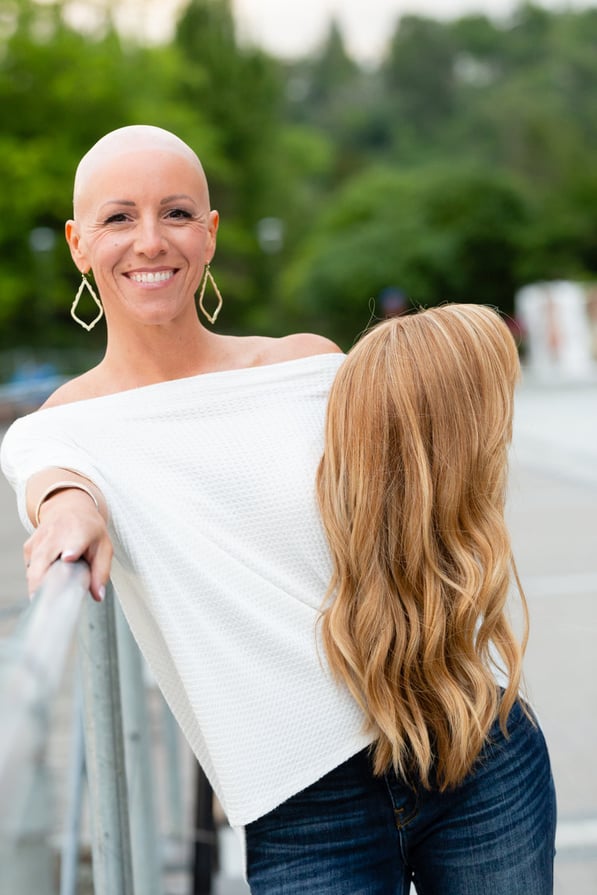
When we talk about alopecia areata, we often talk about what is lost. We talk about the hair, the eyebrows, the eyelashes. But for the women who walk this path, the deepest loss isn't physical: it's the loss of the "narrative."
It's the feeling that your story is no longer yours to tell because your reflection has decided to speak for you.
Kim Karacz knows this feeling intimately. Today, she is a confident business owner, a mother, and a pillar of the alopecia community. But to understand the woman she is today, you have to understand the little girl who, at nine years old, found herself on a "roller coaster" she never asked to board.
The Early Years: A Narrative Out of Control
Kim's journey began with a few small spots. At nine, you're supposed to be worried about playground games and homework, not whether your hair will stay put when you lean forward at your desk. By the fifth grade, those spots had become visible. In the cruel, unfiltered world of eleven-year-olds, the silence was quickly filled with rumors.
"The boys started a rumor saying that I was very sick," Kim recalls. "It was quite upsetting."
It was the first time Kim felt the sting of a narrative getting away from her. Her mother, a registered nurse, had to step in, taking Kim out of school for a day to educate her teachers so they could, in turn, educate the class. It was a necessary intervention, but for a young girl, it was a heavy burden. "It wasn't something anybody necessarily wants," Kim says. "It's not something that I wanted exposed, but the fact that it was already exposed for me, I needed to control the narrative."
The Parade: A Moment of "Terrifying" Exposure
If the fifth grade was about rumors, middle school was about the physical struggle to hide. Kim describes the wigs available to her then as "horrifying" -- ordered out of catalogs, designed for adults, and entirely ill-suited for an active young girl.
Kim was "sporty," and she refused to let alopecia take that away from her. She played softball, wearing her wig under a baseball cap, praying the friction and the sweat wouldn't betray her. Then came the day of the town parade.
Kim was in her softball uniform, riding through the center of town. A young girl, likely thinking she was just playing a game, began flipping the hats off the players. When she reached Kim, she didn't just flip a hat; she sent Kim's "awful, awful synthetic net base wig" flying in front of what felt like the entire town.
"It was terrifying," Kim says, the memory still vivid decades later. In that moment, the "stuff" she had worked so hard to keep private was laid bare. But even in that darkness, there was a glimmer of what community could do. A best friend stepped in, simply saying, "Let's just put it back on and let's go."
That small act of safe connection allowed Kim to keep moving, but the emotional weight of that day stayed with her.
The "Year of Discomfort" and the Search for Hope
Alopecia areata is rarely a straight line. For Kim, it was a cycle of loss and regrowth that she calls a "year of discomfort." By the time she reached her senior year of college -- a time of big decisions about grad school and careers -- she faced her most significant loss yet.
"I think I was in denial that this was all kind of happening again," she admits. But this time, something was different. She was older, more mature, and she was in a relationship with a boyfriend who offered total acceptance. She began to realize that while she couldn't control her hair, she could control how she equipped herself to handle the world.
She remembered a woman she had seen years earlier in a wig that looked so real, Kim couldn't believe it. She tracked down the company (Freedom Wigs in New Zealand) and found what she calls a "life-changing" tool. It was a vacuum wig, a custom prosthetic that allowed her to swim, shower, and even run a Spartan race without fear.
"It was hair that I felt good and confident in," Kim explains, "but then it also made me more confident in having alopecia. When you feel good top to bottom, inside and out, then you're more equipped to handle all of it."
Finding a "Cup-Filling" Community
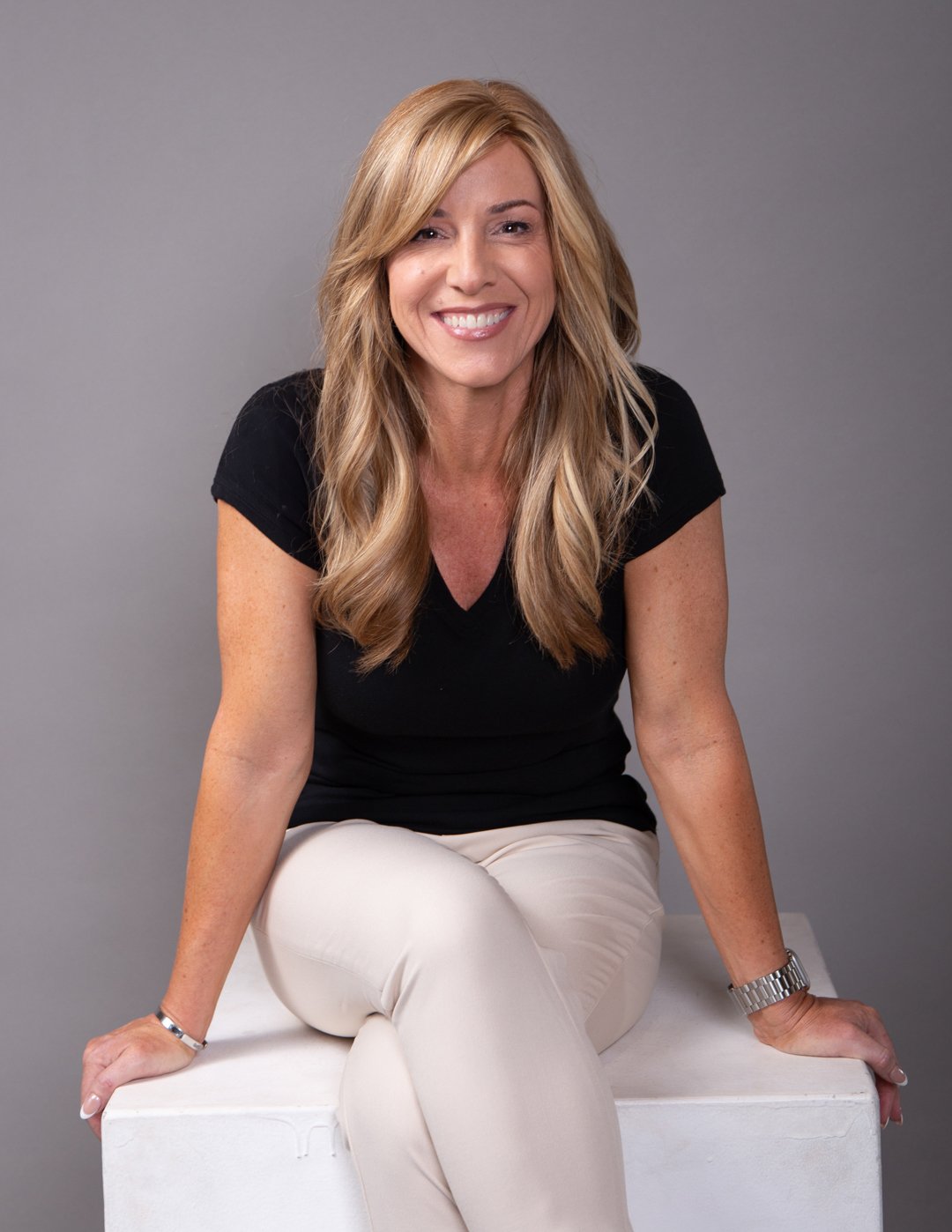
Seventeen years ago, Kim turned her personal victory into a professional mission, starting her company, Second Nature Hair, to help other women find the same "tools" that restored her freedom. It was through this work that she first met Thea Chassin and discovered Bald Girls Do Lunch® (BGDL).
For Kim, BGDL offered something she hadn't found anywhere else: a space specifically for the adult woman.
"I love meeting like-minded people," Kim says. "And there was no pressure either way. Thea presents bald most of the time, but she's also worn one of these [wigs] at a certain point, so she had a respect for it. There was no judgment."
Kim describes the magic of a BGDL lunch as the "dynamic when it's just us." Away from the well-meaning but often overwhelming support of family, spouses, or children, women are free to drop the mask.
"You might have a woman sit down at a lunch and not say much, and really in that she's saying everything," Kim observes. "The rest of us can support her and she can just listen, and that's what she needed in that moment. Then there are other people that have never been able to talk freely about this, openly and without guilt."
In a world that often tells women "it's just hair" or "at least it's not cancer," Bald Girls Do Lunch provides a sanctuary where the real stresses of alopecia are met with genuine compassion and empathy. It's a place where you can "talk shop" about the latest treatments or vacuum wigs, or simply talk about the complexities of being a mom with alopecia.
Why Your Support Matters: The Bridge to Healing
When you donate to Bald Girls Do Lunch®, you’re not just funding a meal; you’re funding the "safe, empathetic, compassionate connections" that Kim believes are the key to resilience.
"Oftentimes finding the right people can speed up that healing process so quickly," Kim says. She looks at the next generation -- like the 16-year-old girl she recently met who was yearning to be part of the community -- and she sees the hope that donor support makes possible.
Kim's advice to her 18-year-old self is the same message she shares with the women she meets at our lunches: "As much as you might want to fight this and try to handle this on your own... you are so much better when you are supported."
Because of kind and generous donors, Bald Girls Do Lunch continues to be that support. Your generosity can ensure that when a woman sits down at our table, she finds "total acceptance" and the strength to "show up the way she wants to".
Kim is "so thankful" that Thea and this organization haven't given up on this work, because the need for real, unbiased, heart-to-heart connection is greater now than ever. Your giving ensures that the next 11-year-old girl, and the woman she will become, never has to navigate the "roller coaster" alone.